Be yourself; Everyone else is already taken.
— Oscar Wilde.
This is the first post on my new blog. I’m just getting this new blog going, so stay tuned for more. Subscribe below to get notified when I post new updates.
Trying to spread more awareness because,The Dinosaurs Didn’t See It Coming Either
Be yourself; Everyone else is already taken.
— Oscar Wilde.
This is the first post on my new blog. I’m just getting this new blog going, so stay tuned for more. Subscribe below to get notified when I post new updates.

Climate Change
I was about seven years-old the first time I heard the phrase “global warming”.
My family and I were at the Toronto Pearson airport, my brother racing through the aisles of the gift shops with myself trailing behind him. At one of the cashier counters, I noticed a book with a picture of our planet in the centre with large, bright red text at the top.

Global Warming, it read. “Global warning? What are they warning us about?” I asked my dad.
It’s been over a decade since I had this conversation with my father and the topic of climate change is still relevant. However now, things have escalated into a potential global mass-extinction.
As that seven year-old child, hearing about habitat loss was the thing that initially made me want to get involved. I had a sudden guilt for assuming that the animals I admired at the zoo would be here forever. As I got older and the topic of endangered species was introduced through school, I realized that I was part of the problem even when I couldn’t directly see it.
There are several examples I could give of the ecosystems we have disturbed throughout human existence, but I was most intrigued by the mass-deforestation in Indonesia induced by the palm oil industry.
Sumatra, Indonesia is home to over 500 different species within its diverse terrain. It is the only place in the world where tigers, rhinos, elephants and orangutans co-exist. Even still, for over half a century this 162 hectare forest has been logged until it has become a fraction of its original size. 80, 316 hectares were lost in just a five-year gap between 2008 to 2013.

What drives the need to destroy this vast ecosystem?
Rows and rows of oil palm; which is found in an assortment of products here in Canada. Including common household items like toothpaste, soap, and even things like chocolate.
Many of Sumatra’s inhabitants are continuously being pushed into extinction because of these plantations. There are currently only 14,600 wild orangutans left but this mass-deforestation not only impacts these species, it affects us too.
Sumatra provides a significant amount of carbon through its rainforest and peat swamps to combat our CO2 emissions.
I think something people neglect to acknowledge is their role in the development of CO2 emissions. It’s a lot easier to blame large corporations or political systems rather than taking responsibility ourselves. Because of this, we have become preoccupied – we focus on economic stability, but this is our demise.
The 2019 Green and Brown report released by Climate Transparency revealed how terrible Canada has been at fulfilling to lower it’s emission targets. Our rate of emissions per capita from vehicles and buildings are substantially higher than the G20 average, with the industry sector totalling a fifth of Canada’s total CO2 production.
The report also stated that over the last decade, 76 per cent of our energy mix has remained dependent on fossil fuels.
The report was disappointing to say the least, especially when the prime minister has promised to have zero emissions by 2050.
With that said, I do find it a little bit easier to now sympathize with those in positions of power after using the balance simulator. It expanded my perspective on the struggle in maintaining a stable triple bottom line (people, planet, profits). It was difficult to keep citizens entertained, their health in tact and produce sustainable energy under a budget.
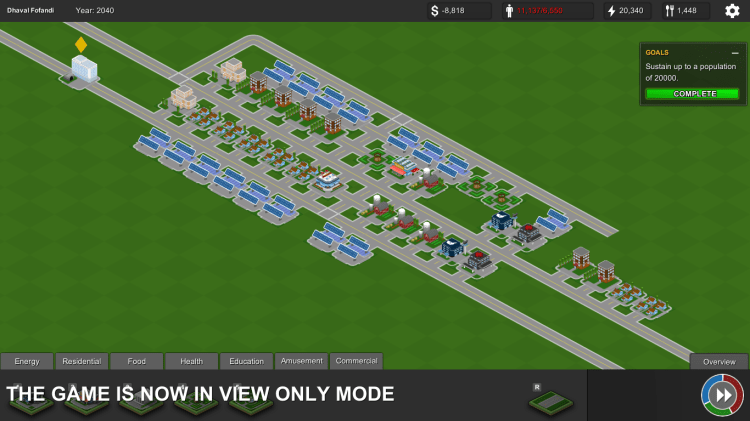
It took me several attempts to fully understand how they all play into one another, so I can only imagine the challenges and obstacles that come up when the simulation is no longer just a computer program.
I just don’t understand those who blatantly disregard the ongoing crisis.
While the results of climate change are an essential component to encourage change amongst our current state, I truly believe that the progression towards a sustainable future is being sabotaged by those in denial.
As we’ve learned in our readings, technology advancements is not what is holding us back.
There is a high level of suspicion towards climate change throughout society; people are questioning the validity of the science behind it because it contrasts their own personal beliefs.
Which is fair – with world leaders like Donald Trump that deny the movement entirely, it makes sense why the trust in science is breaking. This denial, could also be seen as a political strategy.
So why should we trust the evidence and information scientists provide us?
The amount of collaborative research behind the planet’s current state is apparent, there is no singular source to the information provided to the public. It is all a combined effort that routes in relentless peer-review processes for papers being submitted to academic journals, the summary of scientists separate works/findings and the discussions that follow.
Perhaps the issue for some isn’t behind their faith, but more so in defeat.
Being exposed to reality may feel overwhelming to some, especially when you’re unsure of how to make a significant impact. I personally think if more of us made more daily conscious decisions, we would start to see a change – one person doesn’t need to completely be zero-waste in order to make a contribution.
Over the last year we’ve seen several fast-food restaurants switch over plastic straws to paper, or even entirely removing them completely. This is all a chain-reaction to social change. It almost became a trend to carry your own straw around with you everywhere, and this is what we need; more pressure amongst ourselves to start acting regularly.
While yes, cutting straws out may seem like a very small step towards facing such a large problem. We can still use this as an example of the potential we can have at lowering our emissions, it makes if feel a lot more digestible.
In this TedTalk, Chad Frischmann suggests several solutions to reverse global warming. Some are simple tasks, like incorporating more of a plant-based diet into your lifestyle and a decline in the use of vehicles.
Link to the video: https://www.youtube.com/watch?v=D4vjGSiRGKY
We have much to improve on if we want to protect this planet and the life it supports – we are currently at a very detrimental peak. If we aren’t careful now, future generations will not have the same access to water, food, and the overall life experience we have had so far.
I do not want to see people suffer. I do not want to see ecosystems suffer. And I no longer want to be responsible for that. I must make changes, and so should you.
References:
Destruction of elephant, tiger, and orangutan habitat doubles
https://www.orangutans-sos.org/crisis/
This is an example post, originally published as part of Blogging University. Enroll in one of our ten programs, and start your blog right.
You’re going to publish a post today. Don’t worry about how your blog looks. Don’t worry if you haven’t given it a name yet, or you’re feeling overwhelmed. Just click the “New Post” button, and tell us why you’re here.
Why do this?
The post can be short or long, a personal intro to your life or a bloggy mission statement, a manifesto for the future or a simple outline of your the types of things you hope to publish.
To help you get started, here are a few questions:
You’re not locked into any of this; one of the wonderful things about blogs is how they constantly evolve as we learn, grow, and interact with one another — but it’s good to know where and why you started, and articulating your goals may just give you a few other post ideas.
Can’t think how to get started? Just write the first thing that pops into your head. Anne Lamott, author of a book on writing we love, says that you need to give yourself permission to write a “crappy first draft”. Anne makes a great point — just start writing, and worry about editing it later.
When you’re ready to publish, give your post three to five tags that describe your blog’s focus — writing, photography, fiction, parenting, food, cars, movies, sports, whatever. These tags will help others who care about your topics find you in the Reader. Make sure one of the tags is “zerotohero,” so other new bloggers can find you, too.

 Planet Before Profit